Software Architecture & Technical Consulting
Technology Consultancy · From £1,700
Software Architecture & Technical Consulting
VELORIQ
Software Ltd
Technology Consultancy · Service 08
A realistic view of what should move to the cloud, what it will cost to run, and how to get there without a disruptive cutover.

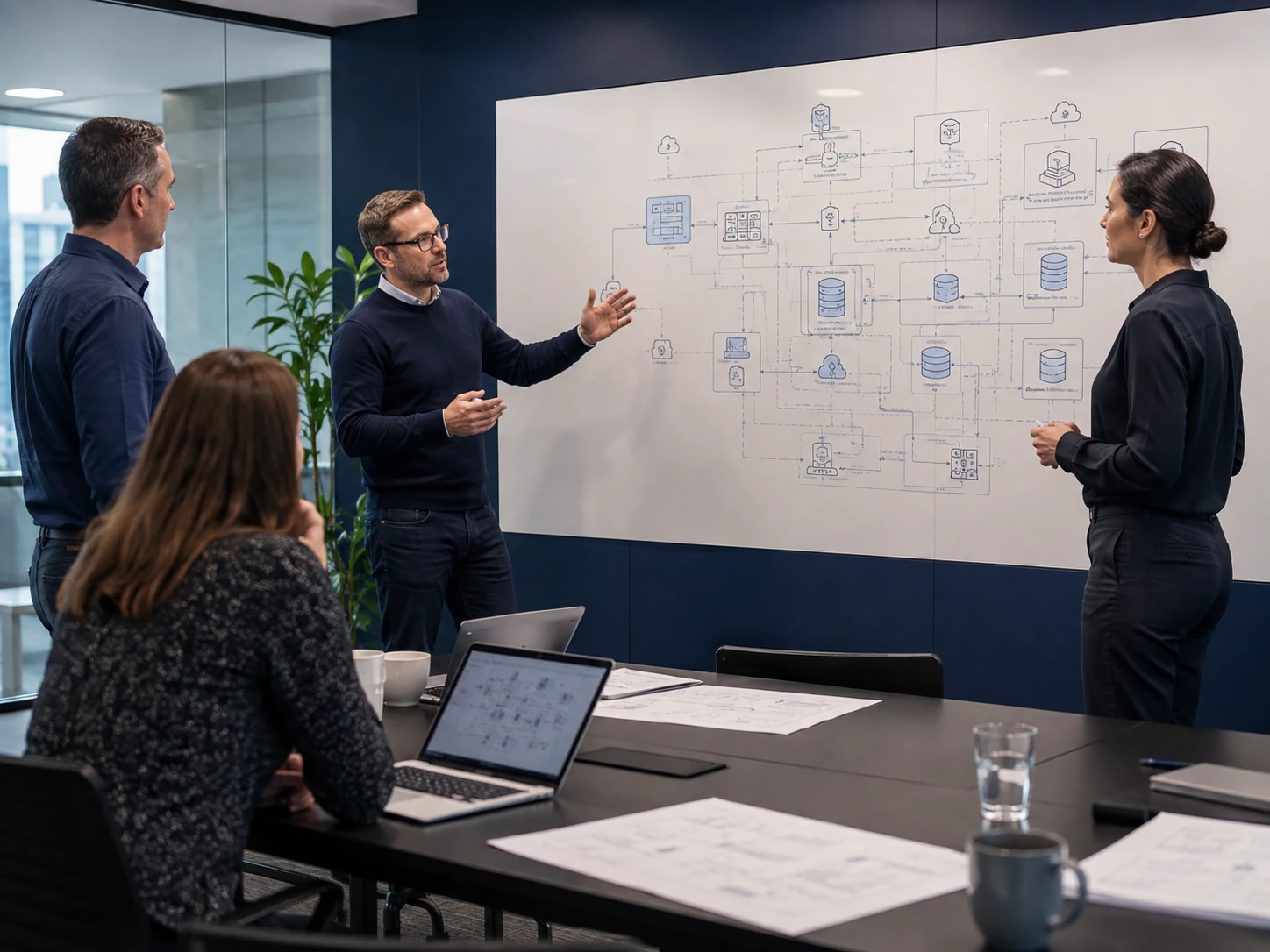
Diagram produced for this page — it describes how the work is actually structured.
Business problems we solve
If more than two of these describe your organisation, the conversation is usually worth having.
Common use cases
Practical examples rather than industry categories — the pattern matters more than the sector.
Comparing another round of on-premises investment against cloud alternatives on a like-for-like basis.
Establishing where an existing cloud bill is actually going and what can be reduced without harming service.
Planning the move of a specific business system, including data, integrations, identity and cutover.
Meeting recovery objectives that the current arrangement cannot support.
Designing for demand that varies by season, campaign or contract without permanently paying for the peak.
Understanding how tied a given design would make you, and what it would take to move again.
What we can deliver
Not every engagement includes every item. Your quotation lists exactly what is in scope and what is not.
What runs where, on what, at what cost, with what dependencies and support arrangements.
A per-workload decision: retain, re-host, re-platform, replace with a managed service, or retire — each with reasoning.
Projected monthly running cost by workload, compared with current cost, including the items commonly overlooked such as data transfer, backup and support.
Networking, identity, environments, storage and security design appropriate to the size of your organisation.
Sequenced waves with dependencies, downtime expectations, rollback routes and success criteria for each.
Identity, least-privilege access, key and secret management, logging and monitoring.
Backup approach, recovery objectives and a documented, testable restore procedure.
Tagging, budgets, alerting and review routine so spend stays visible and accountable.
Our approach
You cannot plan a migration from an incomplete picture. We establish what actually runs, including the things nobody has mentioned.
All-or-nothing cloud positions are usually wrong. Each workload gets its own decision on its own merits.
Including the awkward parts: egress, inter-zone traffic, backup retention, licensing, support plans and the cost of idle capacity.
Start with workloads that carry low risk and clear benefit. Build confidence and capability before touching the systems the business cannot lose.
Every design decision that increases lock-in is identified explicitly, so the trade-off is made knowingly.
Strategic capabilities
Capability relevant to this service. We do not list technology we would not actually recommend.
Project stages
Each stage has a defined output and a review point. You always know where the work stands.
Workloads, dependencies, costs, contracts and constraints established.
Per-workload disposition decided, with cost and risk for each option.
Target architecture, security model and environment strategy documented.
Migration waves, cutover approach, rollback and success criteria agreed.
Advisory support during execution and a post-migration cost and performance review.
Who this service is for
We work with B2B companies, organisations and private clients. The requirement matters more than the size of the buyer.
Related services


Service FAQ
It depends on your workloads, existing licensing, in-house skills and data requirements. We evaluate the mainstream providers against your circumstances rather than starting from a preference. We hold no partner status with any of them.
Sometimes, but it should not be assumed. Cloud usually improves flexibility, resilience and speed of provisioning; direct cost savings depend heavily on workload shape and how well the environment is managed. We model both sides and show you the honest comparison.
No, and most organisations should not. A hybrid position where some workloads remain where they are is a perfectly reasonable long-term answer. The plan should reflect what benefits from moving, not an ambition to empty a server room.
Less so when it is phased. Most workloads can be migrated with a short planned window, and some with none. The disruptive migrations are the ones attempted in a single weekend with no rollback plan, which is precisely what wave planning avoids.
Yes, and it is one of the most frequently requested engagements. A review typically identifies over-provisioned resources, forgotten environments, inefficient storage tiers, unused reservations and data transfer patterns that can be redesigned.
Tell us what you are trying to achieve and we will come back with a clear view of the scope, the approach and the cost.