Software Architecture & Technical Consulting
Technology Consultancy · From £1,700
Software Architecture & Technical Consulting
VELORIQ
Software Ltd
Software Development · Service 06
Bringing software that still does its job into a state where it can be maintained, secured, extended and trusted again.

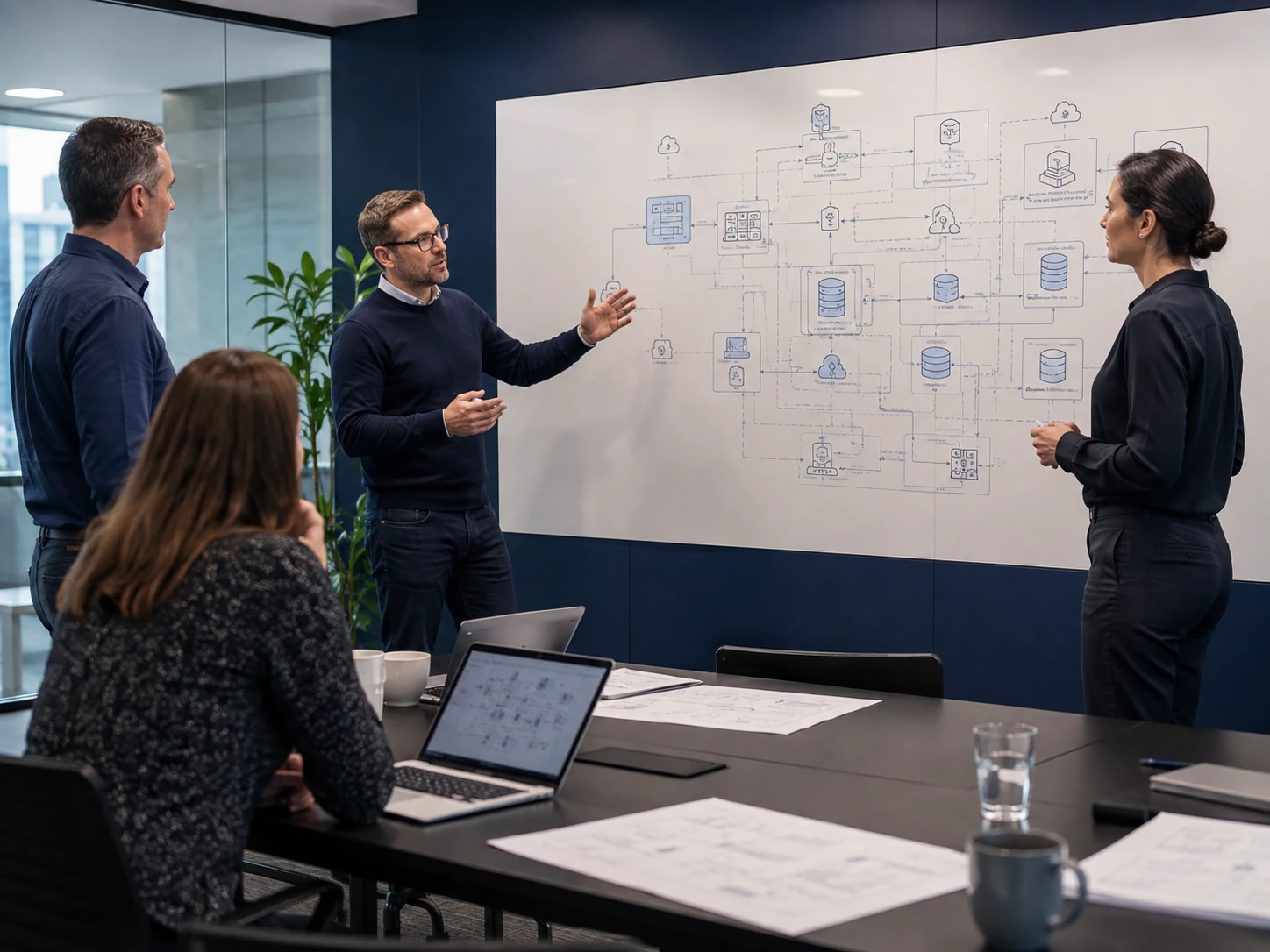
Diagram produced for this page — it describes how the work is actually structured.
Business problems we solve
If more than two of these describe your organisation, the conversation is usually worth having.
Common use cases
Practical examples rather than industry categories — the pattern matters more than the sector.
A system running on a framework or runtime that no longer receives security updates, where inaction is itself the risk.
Software only one party can change, where the priority is documentation, tests and transferability.
Sound logic behind a front end that predates mobile devices and current accessibility expectations.
A system that worked well at a tenth of today’s data volume and now struggles.
An older system that must exchange data with new tools but offers no interface to do so.
Gradually moving functionality out of an old system into new components, without a single high-risk cutover.
What we can deliver
Not every engagement includes every item. Your quotation lists exactly what is in scope and what is not.
Architecture, dependencies, security exposure, test coverage, code health and operational risk, written for both technical and non-technical readers.
Maintain, modernise in stages, replace incrementally or rebuild — each with indicative cost, timescale, risk and consequence of doing nothing.
Runtime, framework and library versions brought to supported releases, with regressions identified and resolved.
Targeted restructuring of the parts that change most often or carry most risk, rather than indiscriminate rewriting.
Tests added around core behaviour first, so that subsequent change can be made with evidence rather than hope.
Updated, responsive, accessible interface applied without discarding the business logic underneath.
Profiling, database and query optimisation, caching and resource handling, measured before and after.
A documented interface placed in front of the existing system so modern tools can use it safely.
Our approach
We read the code, the data and the deployment before recommending anything. A modernisation plan written without that is guesswork.
Tests around current behaviour come before restructuring. Without them, refactoring is simply change with extra confidence.
Each stage is deployable and can be stopped without leaving the system half-migrated. That protects you if priorities change.
Undocumented behaviour is often load-bearing. We identify it and decide explicitly whether to keep it, rather than losing it by accident.
Where full replacement is the destination, we route functionality piece by piece to new components while the old system keeps running.
Technical capabilities
Capability relevant to this service. We do not list technology we would not actually recommend.
Project stages
Each stage has a defined output and a review point. You always know where the work stands.
Code, data, dependencies, hosting and operational risk reviewed and reported.
Costed routes presented with risk and consequence, so the decision is yours and informed.
Tests, monitoring and urgent security work put in place before structural change begins.
Upgrades, refactoring and interface work delivered in reversible, deployable stages.
Parallel running and comparison against the previous behaviour before retirement of the old path.
Documentation, updated deployment process and knowledge transfer to your team.
Who this service is for
We work with B2B companies, organisations and private clients. The requirement matters more than the size of the buyer.
Related services


Service FAQ
That is precisely what the assessment answers. Rewriting is justified when the platform is genuinely dead, when the business process has changed beyond recognition, or when the code cannot be made safe at acceptable cost. Otherwise staged modernisation is usually faster, cheaper and materially less risky.
Sometimes, but the options narrow considerably. Without source code the realistic routes are integration around the system, data extraction, and planned replacement. We will tell you honestly what is and is not possible rather than encouraging you to hope.
Yes. Work is staged so the system remains in service throughout, with changes released in small increments and a rollback route for each. Where a brief planned outage is unavoidable, it is agreed and scheduled in advance.
Yes, and it is common. We can carry out an independent assessment, take a defined workstream, or provide review and mentoring. Where an existing supplier is involved we prefer arrangements that are transparent to everyone.
By capturing current behaviour in automated tests before changing anything, running old and new in parallel on real data where feasible, and involving people who use the system daily. It is the part of modernisation most often skipped, and the cause of most modernisation failures.
Tell us what you are trying to achieve and we will come back with a clear view of the scope, the approach and the cost.